Do I Get How Do I Get My Tablet to Read Me What's on the Screen
by Steve Kelley,CVRT, VisionAware contributor
Overview
Tablet computers, or Tablets, are condign increasingly the device of choice to admission information from the Internet. The Apple iPad, Kindle Fire, and Androids (tablets running Google's Android operating system) are popular tablets. They are light, compact, and very portable—perfect for reading on the go, or to chop-chop access information from a website. Will that smaller size take a negative impact on your ability to access the impress? Will it be too small-scale to read, or have an pick to catechumen the text into speech communication?
Regardless of which tablet you use to access the Internet, you are probably using a Web browser application or app to get to your favorite websites or Cyberspace resources. The Web browser, for case, that comes with the Apple iPad is chosen Safari, the Kindle Fire's Web browser is called Silk and the other Android tablets utilise the default Android Web browser, or Chrome. It doesn't matter which you use, they have some similar features, and some unique, that may brand reading impress a little more accessible.
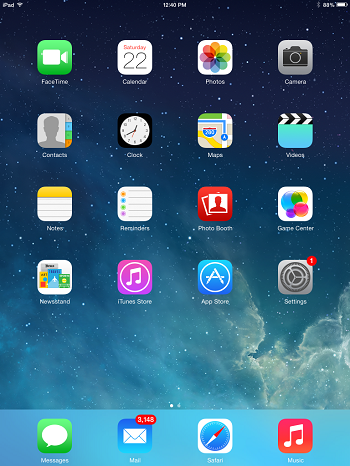
Magnifying Content
One feature, common to most of the tablet Spider web browsers, is a compression gesture used to magnify content on the screen. To make this gesture, hold the thumb and pointer finger together against the screen (as though you lot were pinching something) and slowly spread them apart. You lot will discover that the expanse beneath your fingers is magnified. Reverse the gesture by touching the screen with pollex and pointer finger spread and move them closer together, to reduce the magnification. While magnified, touching the screen with 2 or three fingers and dragging your fingers will motility you around the screen.
Keep in heed, when you accept the screen magnified, yous will see just a portion of the content on the screen at a given time. The greater the magnification, the less yu will see of the screen. Reading a webpage that is magnified may require moving your fingers dorsum and forth to scroll right and left, with each line of text being read.
This pinch gesture, whether it is used on an Android or iPad is somewhat limited to just a few apps. It often only works in the Spider web browser and with some images, such every bit those in a photo gallery. This gesture, for example, will not make the text in the Contacts app or Kindle reading app larger (although at that place may be other ways to do that).
For now, this is where the similarities betwixt the Web browsers stop. Permit's wait at some of the additional features found on the iPad's Safari Browser.
Reading on the Cyberspace with Safari
The Safari Web browser on the iPad has some great features congenital-in to make reading more accessible.
Safari Reader
The Safari Reader is non a characteristic that appears on every webpage, but seems available on many, such every bit newspaper and mag websites, blogs, etc. The Reader is a small-scale button, that when available is positioned to the left of the Address Bar (where you type in the webpage accost or your search terms). The button has several horizontal lines across information technology, replicating lines of text.
When the Reader push is bachelor, touching it changes the appearance of the webpage, putting the text on a evidently background and allowing the user to change many features of the page such equally the font size. Text is also wrapped to the edges of the Web browser window, which ways you will not have to curlicue left and right as you read the page. Touching the Reader button a 2d time will return y'all to the original advent of the webpage.
Speak Screen
With Apple'due south most recent operating system, iOS eight, a new characteristic, called Speak Screen was added in the Accessibility menu, under Speech. With Speak Screen turned on a gesture will initiate the reading of webpages, electronic mail, and the screens of other apps that back up it. Speak Screen is not to be confused with VoiceOver, the built-in text to speech communication feature on the iPad and other Apple devices. Speak Screen may be configured from the Settings bill of fare to be engaged with a two finger swipe down from the condition bar (top center of the screen), or by calculation a button to the carte du jour which appears when text is selected. In one case started, Speak Screen creates a pop-up menu which allows speech to be paused, forwarded, replayed, and the speaking rate modified. The popular-upwardly is visible for a few seconds, then transforms to a much smaller, dimmer push on the left side of the page.
The major advantage of using Speak Screen over the more robust VoiceOver, is that with Speak Screen, none of the other gestures change, as they exercise after VoiceOver is turned on in the accessibility settings.
Of course, the iPad tablet and all the other Apple devices also come up with both Zoom (for screen magnification), and VoiceOver (for text to speech communication). Both features provide greater access to content on the screen and more comprehensive screen magnification and spoken communication access throughout the iPad. Both features are also found on all Apple devices. A more in-depth give-and-take of Zoom and VoiceOver is beyond the scope of this article, however, an splendid resources for more than information is Shelly Brisbin's volume, iOS Access For All, available electronically.
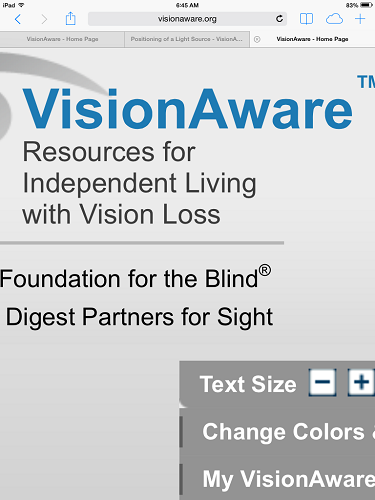
Reading on the Internet with the Silk and Default Android Web Browser
Reading View
The default Web browser for the Kindle Fire is called Silk. As mentioned before, magnifying the webpage may be accomplished using the pinch gesture when the Silk browser is open up. Like Safari, Silk has a reading feature chosen the Reading View. On webpages where this is available information technology appears every bit a tab to the right of the address bar. Selecting the Reading View puts the contents of the webpage onto a obviously background that the user may customize by changing the font style, size, margins, color theme, and spacing. This feature makes it easy to overstate the font and add boosted contrast to webpages.

Screen Magnification
In addition to the pinch gesture, Screen Magnification may be turned on through the Accessibility Settings, to enable screen magnification throughout the Kindle Fire, non just within the Silk browser. With Screen Magnification turned on borer the screen 3 times with a unmarried finger will magnify the screen, a pinch gesture will then adjust the magnification level , and dragging two fingers on the screen will movement effectually the content of the screen.
Voice communication Access
Different Safari, though, there is no speech feature like Speak Screen on the Silk browser. Speech access is merely available by going into the Accessibility Settings and turning the Screen Reader on. On other Androids, this is done by checking Talk Back under the Accessibility menu. Like Safari, with the screen reader turned on, all the gestures alter slightly, so you tin readily access content on a webpage or app, by touching the text or using the various reading gestures.
Default Web Browser on Android Tablet
Because the Kindle Fire is really a customized Android tablet, it is not surprising to acquire that the default Web browser on an Android tablet works much the same as the Silk browser. A pinch gesture volition magnify the content on a webpage, and turning on the Screen Magnifier in the Accessibility Settings will enable magnification throughout all the apps. The default Android browser also may have a built-in Reading View, like the Silk and Safari browsers. Information technology will appear every bit a small box with the letter of the alphabet "R" in the heart to the right of the address bar when information technology is available. The Android browser has fewer options than either Silk or Safari. Content is placed on a manifestly background and the font size simply is customizable. For a reading feature with more options try 1 of the 3rd-political party Web browsers available at no accuse from the Google Play Store such equally: Mozilla FireFox or Dolphin.
Like the Silk browser, the default Android browser has no built-in text to speech characteristic other than Talkback , enabled from the Accessibility settings. Again, for more than options, consider some of the popular third-party alternatives such as the Google Chrome Web browser with Browser Reader installed, or a Web browser similar Web Page Reader with text to oral communication already built-in.
Summary
Tablets are offering increasingly greater admission to print on the Net and through their respect Web browsers. Overall, the Apple tree iPad offers the widest assortment of customized features built into the iOS operating system. The default Android Spider web browser and Kindle Fire's Silk provide customizable features, specially for the low vision reader looking for larger print access. Depending on what your preferences are for accessing impress, yous may notice 1 of these tablets volition provide equally much, or greater reading access than your full-size calculator.
More Information
Using Your Kindle
Choosing the Right Device
Low Cost Calculating
How to Magnify Using Zoom Feature
gillmanefivishereme1974.blogspot.com
Source: https://visionaware.org/everyday-living/helpful-products/using-a-computer/reading-on-the-internet-with-a-tablet/
0 Response to "Do I Get How Do I Get My Tablet to Read Me What's on the Screen"
Post a Comment