Mario & Luigi Superstar Saga Bowsers Minions Review
This is almost the series. For the graphic symbol, come across Mario.
Mario (or Super Mario ) is a long-running media franchise developed and produced by Nintendo. The titular character of the franchise is Mario, a fictional Italian plumber who serves equally the hero of a place called the Mushroom Kingdom. The franchise was started past game designer Shigeru Miyamoto, with the offset installment existence Donkey Kong, an arcade game that was released on July nine, 1981.
The games were primarily developed and self-published internally by Nintendo, while other companies such as Hudson Soft, Foursquare Enix, AlphaDream, Retro Studios, and several more, developed Mario games nether Nintendo's supervision. Beginning with third-generation consoles onward, near installments in the serial take been developed for diverse Nintendo game systems and handhelds.
The Super Mario series is the main one of the franchise, consisting of platformer titles that usually revolve around Mario and Luigi protecting the Mushroom Kingdom and Princess Peach from Bowser and his Koopa Troop. Both brothers make use of their trademark jumping ability that effectively allows them to continue through levels, and are too able to acquire a multifariousness of useful ability-ups. The franchise too consists of other genres which include racing games such as the Mario Kart series, sports such every bit Mario Lawn tennis, role-playing games (RPG) such as the Mario & Luigi series, and several educational games.
The Mario franchise totals over 200 video games, with a combined selling of over 600 million copies. Mario besides has appearances in other media such equally comics, television serial, books, and a characteristic movie. Being the flagship franchise of Nintendo, Mario has garnered massive critical acclaim and is highly recognized worldwide as the best-selling franchise.
Contents
- 1 History
- ane.1 Pre-NES Era (1981 – 1985)
- 1.2 NES and Game Boy Era (1985 - 2001)
- 1.three SNES Era (1990 - 1996)
- i.4 Nintendo 64 Era (1996 - 2001)
- one.five Nintendo GameCube, Game Boy Advance, and Nintendo DS Eras (2001 - 2011)
- 1.6 Wii Era (2006 - 2012)
- ane.vii Nintendo 3DS Era (2011 - 2019)
- 1.8 Wii U Era (2012 - 2017)
- i.9 Nintendo Switch Era (2017 - Present)
History
Pre-NES Era (1981 – 1985)

Mario'southward first appearance in 1981.
The Mario series began in 1981 with Donkey Kong. Created by Shigeru Miyamoto, Donkey Kong was Nintendo's showtime big success. Originally, Mario was known as Jumpman, but information technology was later changed to the former when Nintendo of America nicknamed the character Mario afterward their landlord, Mario Segale.
Mario returned to the series as the villain of Donkey Kong Jr. Yet, he was replaced by Stanley the Bugman in Donkey Kong 3.
However, in 1983, Mario got his own game,Mario Bros. This besides was the first game to feature Luigi.
Mario and Donkey Kong also appeared in several Game & Sentry games.
NES and Game Boy Era (1985 - 2001)
Mario'southward first outing on the NES was Super Mario Bros. It sold around forty million copies worldwide, making it the best-selling game of all time. The game introduced many of the hallmarks of the serial including Bowser, Princess Peach, Toads, Mushrooms, Fire Flowers, Starmen, Koopa Troopas, and Goombas.
In the wake of the success of Super Mario Bros., a sequel, Super Mario Bros. ii, was released in 1987. In Nihon, the game was like to Super Mario Bros. It was later released in America as Super Mario Bros.: The Lost Levels on the Wii'south Virtual Console and the compilation, Super Mario All-Stars. In America, Super Mario Bros. 2 was the same as the Japanese game Doki Doki Panic, just with Mario characters. The American version allowed players to play as Princess Peach and Toad for the showtime fourth dimension and was re-released in Japan as Super Mario Us.
In 1989, Mario made its debut on the Game Boy with Super Mario Land. It sold 18.06 million copies, making it the bestselling game not bundled with a console in history. This game introduced the proficient friend of Mario's, Princess Daisy. The sequel was Super Mario Land 2: 6 Aureate Coins, released in 1992, which introduced Mario'southward rival, Wario.
Mario returned to the NES in 1990 with Super Mario Bros. 3. The game returned to the formula of Super Mario Bros. It introduced many new powers such as the Super Foliage, Tanooki Suit, Hammer Arrange, and Frog Suit. It also was the start appearance of the Koopalings. It sold 17.8 million copies.
In 1990, Mario became a dr. with Dr. Mario.
In 1999 and 2000, Mario became a sport hero with Game Boy titles Mario Golf and Mario Tennis (Game Boy Color).
SNES Era (1990 - 1996)
In 1991, Mario debuted on the Super Nintendo with Super Mario World. This game introduced Mario's companion, Yoshi. Information technology sold 20.threescore million copies worldwide.
In the aforementioned year, Mario prepare the standard for cart racing games with Super Mario Kart. It was at the time (and some say, still is) the best racing game bachelor.
In 1993 a game drove chosen Super Mario All-Stars contained Super Mario Bros., Super Mario Bros.: The Lost Levels, Super Mario Bros. two and Super Mario Bros. iii with better music and graphics, released.
In 1994, Toad and Wario closed the NES with a bang with the puzzle game,Wario's Woods. It is the simply game to star Toad as the only hero.
In 1995, Mario returned to the Super Nintendo every bit a baby in Super Mario Earth 2: Yoshi's Isle. Instead of controlling Mario, the role player controls Yoshi.
Mario's last game on the Super Nintendo had him delve into the RPG genre. Super Mario RPG: Fable of the Vii Stars is fondly remembered by fans and is often listed equally one of the acme games for the Super Nintendo. Interestingly, this is the first game that lets players play every bit Bowser.
Nintendo 64 Era (1996 - 2001)
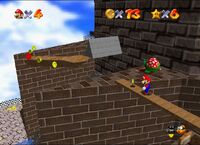
Mario looking around in Super Mario 64.
1996 was a landmark year for the Mario series. It was the year that Super Mario 64 was released. The game made the transition from 2D to 3D very well and fix an instance for how 3D platformers should feel. The game sold 11.62 1000000 worldwide, making information technology the bestselling game for the Nintendo 64.
The next game in the Mario Kart series,Mario Kart 64, was released in 1997. This game has been criticized for not feeling as speedy as Super Mario Kart.
In 1999, Mario was once again pushed in a new direction. Mario Political party was an odd concept: a combination of a lath game and video game. However, it was very well done and an first-class game to play with friends.
Another new idea developed in 1999 was Mario and sports. That yr, Mario Golf was released and well received.
Perchance the strangest departure that year was a fighting game. While Super Smash Bros. isn't technically a Mario game, information technology is still noteworthy. The game featured characters from some of Nintendo's most popular franchises. It went on to get the fifth bestselling game for the Nintendo 64.
In the year 2000, Mario tried out another sport. Mario Lawn tennis was equally successful equally Mario Golf game was before information technology.
In the year 2001, Mario returned to the RPG genre, but with a new twist. Paper Mario featured the hero equally a paper cut out.
Nintendo GameCube, Game Boy Advance, and Nintendo DS Eras (2001 - 2011)
The GBA was released on March 21, 2001. In its launch was Super Mario Accelerate, which was a remake of the American Super Mario Bros. 2, adding new graphics and a few new additions, such as a remake of Mario Bros. that could exist played with four players.
In 2001, Luigi got his own game, Luigi's Mansion. The game strayed abroad from platforming and focused on the apply of the Poltergust 3000 to solve puzzles and capture a haunted house's ghosts.
2001 as well saw the sequel to 1999's fighter Super Smash Bros. with Super Smash Bros. Melee, the best-selling game on the GameCube.
Also in 2001, the sequel to Mario Kart 64, Mario Kart: Super Circuit, released. This game was very like to Super Mario Kart, except 32-bit, not 16-bit. Super Mario Advance 2 came out early in 2002. A remake of Super Mario World, it had new graphics, but dissimilar the original Accelerate, information technology had many new features.
In 2002, Mario returned in Super Mario Sunshine. Like his brother, Mario was wielding a new device, in this case, F.L.U.D.D.
Also in 2002 was Super Mario Advance 3. Information technology was a port of Yoshi'south Island. It had well-nigh cypher new, not even graphics.
In mid-2003, Mario Golf game had a huge update on the GCN with Mario Golf: Toadstool Bout. It did not take any of the humans from the original, simply information technology added tons of new features to add to its wackiness, plus a new, easier mechanic for swings.
Mario had his commencement RPG on a portable organisation in 2003. For the Game Male child Advance, Mario & Luigi: Superstar Saga featured both of the brothers fighting simultaneously.
Another game released in late-2003 was Mario Kart: Double Nuance!!, the sequel to Mario Kart: Super Circuit.
2004'south Super Mario Accelerate 4 was more or less a port of Super Mario All-Stars'due south remake of Super Mario Bros. iii, but information technology had a few tiny changes, such as yet some other Mario Bros. remake addition.
In 2004, Mario Golf: Advance Tour was released. It was a lot like the GBC version of Mario Golf, but at present information technology has new characters, courses, and 3D graphics. There were RPG elements to the game, likewise, which meant one's grapheme stats could be totally different from others of the same character. It was possible to link to Mario Golf game: Toadstool Tour and transfer characters to it.
Mario went back to his roots and went up against his quondam antagonist Donkey Kong for the first time in ten years in 2004. Mario vs. Donkey Kong'south gameplay was like to Donkey Kong '94's gameplay, but with entirely new levels.
In 2004, the sequel to Paper Mario came out: Newspaper Mario: The Thousand-Year Door played similarly to its predecessor, but in a new setting with an unrelated story.
In 2004, Mario Ability Tennis, the sequel to 2000's Mario Tennis, was released. information technology featured several new characters and modes, along with Power Shots.
On November 21, 2004, Nintendo released its new console, the Nintendo DS with a port of Super Mario 64 for the Nintendo 64, Super Mario 64 DS.
2005 stretched Mario's boundaries a bit further by adding rhythm games to his resume. Dance Dance Revolution: Mario Mix featured remixed games too every bit characters from the Mario series.
Mario also tried a couple of new sports in 2005. Mario Superstar Baseball mixed the great American pastime with Mario. Super Mario Strikers, on the other hand, mixed the Mario with the excitement of soccer/football.
The GBA version of Mario Power Tennis came out in 2005, chosen Mario Tennis: Power Bout. It was much like the GBC Mario Tennis, with RPG elements and Humans. Unfortunately, the GCN version could not link up to it.
Tardily in that same year, two DS titles came out featuring Mario. They were Mario & Luigi: Partners in Time, which was the sequel to Superstar Saga, throwing time travel and Baby Mario and Luigi into the RPG fray, and Mario Kart DS, which was the very first Nintendo online game. Information technology included, along with 16 new courses, 16 erstwhile favorites, four from each of the past Mario Karts.
Princess Peach got her own game in 2006. Super Princess Peach is an easier platformer than the previous Mario platformers, but it has its own unique characteristics.
2006 was the year of the Nintendo DS for Mario. The Mario Bros. series has been continued in a unique way with the New Super Mario Bros. With new abilities and the quondam platforming action, the game is truly a worthy successor and became the all-time-selling game for the Nintendo DS.
Mario tested his skills on the courts with Mario Hoops 3 on 3. Along with his usual friends, he also went up confronting some opponents from the RPG Serial Final Fantasy.
The SNES's Yoshi'due south Island was succeeded with Yoshi's Island DS. This time, the game featured the younger versions of several favorite characters, including Infant Peach, Baby DK, and many others.
In 2007 and 2009 respectively, Mario and Sonic compete for the Olympics with Mario & Sonic at the Olympic Games andMario & Sonic at the Olympic Wintertime Games.
Wii Era (2006 - 2012)
2007 brought on new sequels to classical Mario games, such as Super Paper Mario (Newspaper Mario series), Mario Party 8 and Mario Party nine (Mario Party series), Mario Strikers Charged (Mario Strikers series), Super Mario Milky way (sequel to Super Mario Sunshine). Later in 2008, Super Smash Bros. Brawl (Super Smash Bros. serial) and Mario Kart Wii (Mario Kart Series) were released. Mario Super Sluggers (Mario Baseball series) was also released. In 2009, New Super Mario Bros. Wii was released. In 2010, the sequel to Super Mario Galaxy, Super Mario Galaxy 2, was released.
Nintendo 3DS Era (2011 - 2019)
The Mario series added a new game to the Super Mario Land serial for the Nintendo 3DS with Super Mario 3D Land. Ii spin-off games, Newspaper Mario: Sticker Star and Mario Kart 7, were too appear. In August 2012, a new game for the New Super Mario Bros. series, New Super Mario Bros. 2 was released. In 2013, the very popularMario & Luigi: Dream Team and not so knownMario Political party: Island Tour was released. Also, remakes for the old Mario & Luigi RPG serial were released: Mario & Luigi: Superstar Saga + Bowser's Minions and Mario & Luigi: Bowser's Inside Story + Bowser Jr.'s Journey in 2017 and 2019 respectively..
Wii U Era (2012 - 2017)
Most the end of 2012, Nintendo released a new Super Mario installment for the Wii U, called New Super Mario Bros. U. At that place was a different version of New Super Mario Bros. U, called New Super Luigi U, released for the Year of Luigi. Another game, Super Mario 3D World, was released as well. The Super Mario serial has started from Mario's appearance in Donkey Kong. Later on on, creators have been making Mario games like Super Mario Bros., Paper Mario: The Yard-yr Door, and so on. In 2014, a spin-off, Captain Toad: Treasure Tracker was released for Wii U consoles. Also in 2014, Nintendo released Mario Kart viii. It went on to become the best-selling Wii U game with over 7 one thousand thousand units. Mario Party 10 was released in 2015. Also in 2015, the Mario franchise turned thirty years old. To gloat this, Nintendo released Super Mario Maker. The game was a level designer, that allowed users from all over the earth to submit creative, and maybe a few not-so-creative, levels.
Nintendo Switch Era (2017 - Present)
The first Mario game for the Nintendo Switch was Mario + Rabbids Kingdom Battle, releasing five months later the system launched. The first mainline Mario game released for the arrangement, however, was Super Mario Odyssey. A remake for the not-and so-successful platformer New Super Mario Bros. U was released in January 2019, titled New Super Mario Bros. U Deluxe. Another installment to the Yoshi series was also released, chosen Yoshi's Crafted Earth. A sequel to Super Mario Maker, named simply Super Mario Maker ii, was also unveiled for the Switch in June 2019, and a third Luigi's Mansion, Luigi's Mansion 3, was presented in October 2019. A new Paper Mario game titled Paper Mario: The Origami King released on July 17 in 2020. In 2021, Mario Golf: Super Rush took part on golf game courses, and Mario Party Superstars was partying.
gillmanefivishereme1974.blogspot.com
Source: https://mario.fandom.com/wiki/Mario_(series)
0 Response to "Mario & Luigi Superstar Saga Bowsers Minions Review"
Post a Comment